The Easy Era Is Over. Here's What It Takes to Build for What Comes Next
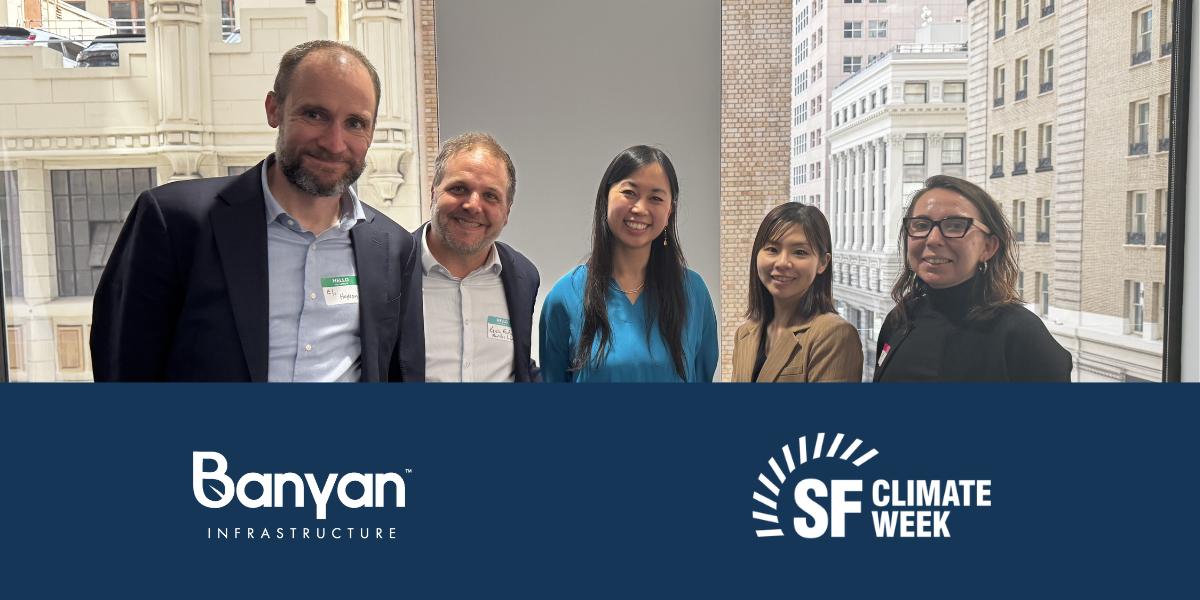
At Banyan HQ during San Francisco Climate Week 2026, our COO & Co-Founder Amanda Li moderated a Banyan Connect conversation on building and financing distributed infrastructure in a limited-ITC world. Joining the panel were Kevin Fanfoni, Director of Capital Markets, Nautilus Solar; Eli Hopson, Chief Commercial Officer, CGC; Marisa Sweeney, Principal, S2G Investments; and Satoko Wakasa, VP of Capital Markets & Strategy, Nexamp.
Despite the policy noise, the conversation was distinctly optimistic, grounded in steep retail-rate growth, resilient state-level incentive programs, a rapidly growing storage pipeline, and structural load growth that continues to expand the opportunity set for distributed generation and community solar.
Building & Financing Distributed Infrastructure in a Limited ITC World
The "easy" era of distributed generation is over. If your team is heads-down pushing safe-harbored projects across the finish line while simultaneously rebuilding the operating model for what comes next, you are not alone. Every developer, financier, and green bank in the room said the same thing.
The question that ran underneath every topic was the same: when the subsidy stops doing the heavy lifting, what carries the weight? The panel kept returning to the same answer of better data, more disciplined risk, and the operational rails to move capital at industrial scale.
State of the market: optimism, with receipts
Even against the backdrop of shifting tax credits, fluctuating tariffs, and state-level policy reversals, the panelists were genuinely optimistic, and grounded in specifics worth pulling out:
- Rate-curve growth is making community solar more valuable, not less. Even in jurisdictions like Maine, where retroactive legislation took a bite, the underlying retail-rate growth was strong enough that the net impact on operating projects was effectively a wash.
- Storage is no longer a "future" line item. Multiple developers on stage are actively building their first or expanded standalone storage projects. Its standalone ITC runs well past the residential and commercial solar phase-out, and stacked state incentives and grid-services revenue give the asset class a more stable financeability case than solar-only carries today.
- Transferability has quietly become the unsung win of this cycle. Section 6418's direct-sale mechanism sidesteps the gated tax-equity market and opens monetization to deal types that have never been penciled before. One panelist noted that projects that "would have never been able to get through" in a 15-year career are now actually getting built.
- Consolidation is real, and capital-rich players are positioning to buy distressed assets — a structural reshaping of the developer landscape, not just noise.
The forward path is not "wait out the policy cycle"; it is to build operating models that pencil without subsidy as the primary lever. As one speaker put it, "It's time to grow up as an industry." The interim will be uncomfortable. The destination is a more durable industry.
Risk discipline in a "FOMO vs. not-FOMO" market
Underwriting has gotten more skeptical and more structurally creative in the same breath. Panelists described pressure-testing every base case against scenarios they used to treat as tail risks, including binary policy events and sudden caps on retail power prices that could reset levered project economics overnight. The discipline has a name: don't get "too drunk at the party," but don't miss the party either.
For developers, that has translated into investors asking sharper, sponsor-level questions much earlier:
- What does your pipeline look like through the post-ITC transition?
- What is the platform's revenue plan when ITC is no longer the central column?
- How exposed is the portfolio to single-state policy regimes — and how diversified is the offtake mix?
The data-center conversation followed the same logic. Hyperscale loads sit at hundreds of megawatts to gigawatts; DG sits at 5–10 megawatts. The honest answer from the panel was that DG won't directly serve hyperscale demand. The indirect benefit is more durable: the entire C&I world has woken up to the value of hedging power costs, and "a 2.5% escalator PPA from 2018 looks really smart now."
The technology thread: from Excel to AI-native, through a single source of truth
This is where the panel's thinking converged most clearly with how we think about the work at Banyan. You cannot leverage AI on top of data that lives in 40 spreadsheets. The promise of AI in project finance is not the model itself; it is what the model can do once it has clean, structured, retrievable data to work against.
Drag a frontier model onto a project record that lives across a dozen file servers, three CRMs, an accounting system, four versions of the same Excel workbook, and a year of email threads, and the answers you get back are confidently wrong. Drag the same model onto a single source of truth that has already done the work of normalizing covenants, contracts, performance data, and counterparty records, and the answers start to actually move the needle on diligence speed, covenant tracking, and portfolio reporting.
Multiple panelists described the same arc: they grew from 30-megawatt, Excel-era operations into multi-gigawatt, multi-hundred-person platforms, and the only way that scaling held together was migrating the entire operating record onto a centralized warehouse: a single source of truth for projects, contracts, and performance. The migration itself is the unglamorous part of the work. It is also the prerequisite for everything the panel got excited about next.
From there, AI starts to earn its place. Specific examples from the panel:
- Leveraging AI to prep diligence calls ahead of time, so panelists can compress three meetings into one and respect founders' time.
- AI-assisted data-room review that takes some of the "brain damage" out of pushing a DG portfolio across a lender's desk.
- Drafting, data curation, outlining, and (yes) all types of graphics that have been automated away in day-to-day workflows.
What AI is still terrible at, per the panel: writing prose anyone wants to read, drafting legal contracts, and producing reliably correct answers without a human checking the work. The takeaway is not that AI replaces the operator. It is that the operators with clean, organized data get to compound the productivity gains while the rest spend the cycle catching up on hygiene.
Building the rails: standards, securitization, and interoperable data rooms
The room kept coming back to the structural question: what will it take for distributed generation to access the kind of liquid secondary markets that commercial real estate enjoys? Today, community-solar-backed securitization is essentially a zero-dollar-a-year market against a trillion-dollar comparable.
The panel's hypothesis, in plain terms:
- Warehouse capital is a bridge, not a destination. Projects are coming into operation faster than long-dated capital is showing up to absorb them. Warehouse-to-secondary market rails need to mature so assets can move from interim financing into permanent hands without stalling on the span..
- Rating-agency engagement is non-optional. Telling a cohesive story to Kroll and the rest, including payment performance, subscriber behavior, jurisdictional diversification, is how the asset class moves from "black box" to ratable.
- Consolidated billing in major community-solar markets is a quiet but significant tailwind for offtake credit quality.
- Is the juice worth the squeeze? Layering ABS (asset-backed securities) structuring on top of an already-complex post-ITC capital stack only makes sense once the bandwidth and operational expertise exist to do it well.
- Interoperability between developers' and financiers' data warehouses is the prerequisite. If a lender can pull an identical, AI-diligenceable project record from any developer in its network, the cost-to-securitize collapses.
Liquidity in DG won't come from a single magic structure; it will come from standardized data rails that make the asset class diligenceable at scale. Asked for a thumbs up or down on whether DG-backed securitizations will be at scale by 2030, the panel went thumbs up, and the room agreed.
The path past the hype runs through the same place it always does: bulletproof data, standardized rails, and the partnerships that turn isolated wins into a market. Banyan Connect exists for that last part: to give the developers, financiers, and green banks in this ecosystem a place to compare notes, find counterparties, and build the operating system for distributed infrastructure together.
We'll see you at the next one. Continue the conversation with us by getting in touch.