Solar + Wind Recap: Financing Community Solar, C&I, and Smaller-Scale Projects
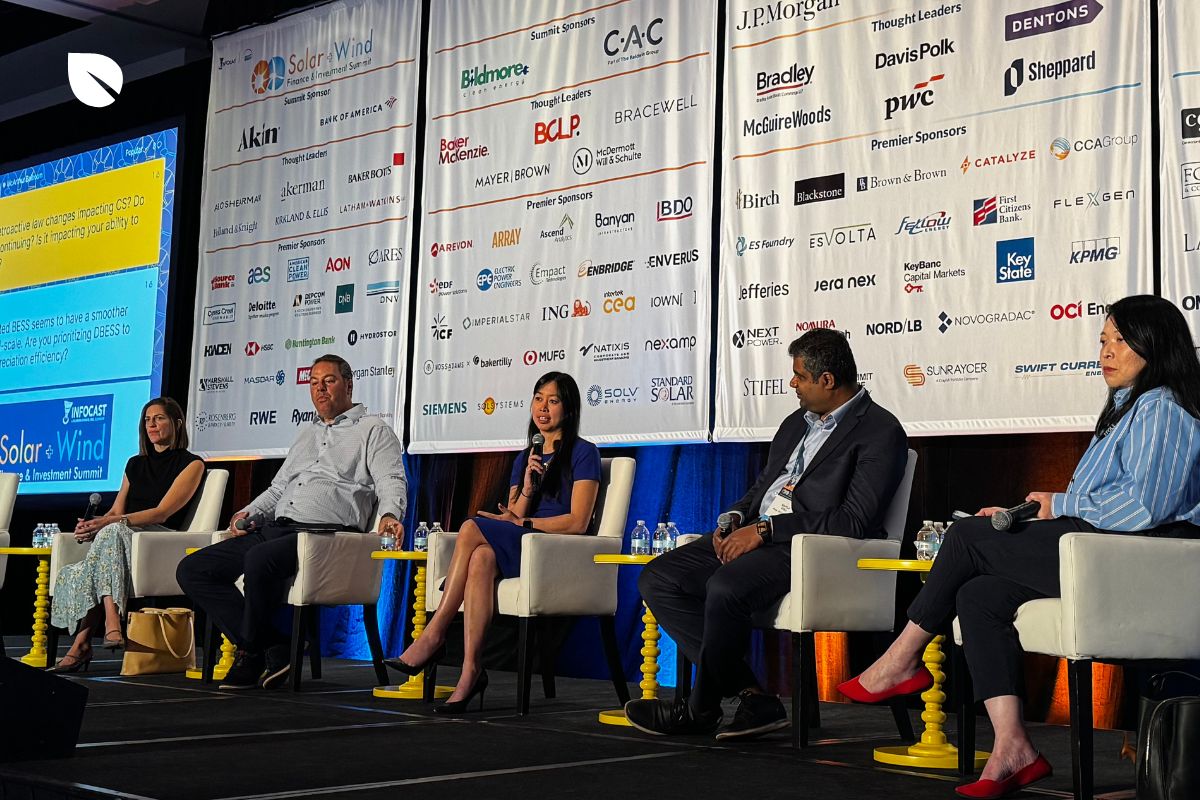
The distributed generation (DG) landscape is evolving rapidly, with shifting regulatory environments, interconnection hurdles, and a growing emphasis on portfolio sophistication. At this year’s Solar + Wind Finance & Investment Summit in Phoenix, our COO & Co-Founder Amanda Li joined a group of industry experts to discuss the current state of financing for community solar, commercial and industrial (C&I), and smaller-scale projects.
The following key takeaways summarize the panel’s collective insights.
What Makes a Portfolio "Fundable"?
The speed at which a project moves from pitch to funding often depends on more than just the numbers, it requires deep market knowledge and a conservative view of construction timelines. While smaller projects are often perceived as "easier," they frequently take much longer than expected to reach Permission to Operate (PTO).
Success in this environment hinges on a borrower’s ability to navigate "liquidity crunches"— understanding exactly when they need capital and building in buffers to account for inevitable delays. Ultimately, the strongest developers are those who establish bank relationships early and to be transparent about potential issues months in advance rather than days before a deadline.
The Rise of Portfolio Sophistication
As the industry matures, the way portfolios are managed is shifting from "spreadsheet-heavy" manual tracking to sophisticated, data-driven asset management. Investors are moving away from "chasing the shiniest object" and toward a holistic view of portfolio risk. This includes balancing geographic exposure, borrower concentrations, and regulatory environments across different states.
"Long-tail" of new lenders—including Green Banks and CDFIs—are entering the space, bringing new pools of capital to sub-5 megawatt projects.
Navigating a Post-ITC World
With the Investment Tax Credit (ITC) expected to shift or phase out, the industry is already looking for ways to adapt. A necessary market correction is anticipated once the current ITC cycle concludes, requiring a downward shift in EPC (Engineering, Procurement, and Construction) and a decrease in module prices to keep the fundamentals of solar projects viable.
Despite these shifts, there is collective optimism regarding the trajectory of the industry. As platforms mature, the accumulation of robust operating data will allow for significantly more accurate success forecasting. This points to a future defined by standardized hybrid products and the support of AI agents, both of which are expected to lead to even more liquid markets and institutional investment.
Market Snapshots: From New York to Maine
The discussion concluded with a discussion on specific regional challenges highlighting how state-level policy and grid constraints dictate project viability.
- Maine: Recent legislation affecting community and other front‑of‑the‑meter solar projects has introduced retroactive adjustments to compensation and fees that materially impact project economics and long‑term contract structures for existing and in‑development assets. As stakeholders reassess risk and redeploy capital, many developers and investors are prioritizing markets with clearer forward visibility, such as Ohio, Michigan, and Delaware.
- Pennsylvania: While many financiers remain wary, taking a conservative view on Pennsylvania—with an eye toward an eventual community solar pivot—can still be a viable strategy.
- Energy Storage: Distributed storage is becoming an "easy segue" for community solar developers. Storage has a smaller land footprint, making it highly compelling for major urban centers like New York, Chicago, and LA.
Rounding out the panel with Amanda were Danielle Thompson, Managing Director of Fundamental Renewables; Jared Haines, CEO of Catalyze; Sayoji Goli, Managing Director of First Citizens Bank; and moderated by Annie Y. Tsai, Senior Counsel of Foley & Lardner.